


Revisiting the Arctic: A Natural History Study in Gipsdalen and Sassendalen

Updated: Mar 11

The flora and fauna research project revisited a study first carried out by the 1983 Polar Exploration Group expedition, whose members included founder members of the ARG, allowing the comparison of the ecological conditions in this area of Svalbard, across more than four decades. As described below, the work involved identifying a wide range of plant
species within the region’s very short 6–10-week flowering window, a brief moment
of life in an otherwise harsh Arctic landscape. By returning to the same locations in Gipsdalen and Sassendalen and repeating the original transect-based methods, it was possible to examine how species presence, ground conditions, and wildlife activity have shifted during 42 years of rapid environmental change.
The team carefully planned each field visit to retrace the steps of the 1983 expedition
as precisely as possible. Using maps, compass bearings, and written coordinates
from the 1983 field notes, location were cross-referenced with modern GPS data to
relocate every transect line, riverbank survey point, and cliff route.
Over several days, beaches riverbeds, and historical bird-nesting cliffs were revisited
to replicate the original study design in as much detail as the conditions allowed.
Although the 2025 field season offered less time in each valley, the repeated
methodology ensured continuity in the observations.
Images © Richard Hill, Natalia Sarmanto and joseph Ricketts
Environmental tests played a central role in allowing the comparison to present-day
conditions with those recorded in 1983, and each field visit required careful
preparation to ensure that measurements were both accurate and repeatable.
Soil pH, ground temperature, subsurface temperature, relative humidity, slope and aspect
were all recorded at fixed 50-metre intervals along the transects, meaning that even
small inconsistencies in equipment handling could affect the comparability of the
datasets. Sensitive instruments such as temperature sensors, clinometers, GPS
devices, and weather meters needed to be calibrated daily as exposure to cold air,
moisture, or shifting temperatures in the field could influence their readings.
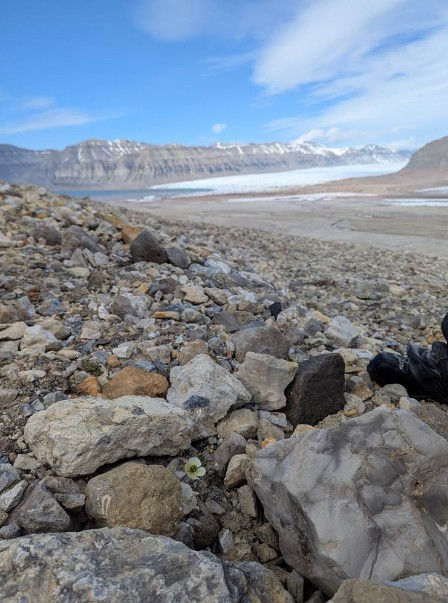
The research sites took the team on a journey of exploration across the Svalbard
landscape. From lush valleys, up harsh scree slopes, to crowded bird-cliffs, even
traversing an ice laden Fjord by boat across the snout of a calving glacier. The resilience and
beauty of the natural life within the region was awe inspiring, finding purchase in
even the most unlikely and precipitous of places.
Arctic ecosystems are incredibly sensitive to temperature, meltwater patterns, and
nutrient flows. By comparing identical study sites across four decades, the project
documents not only which species persist, but how the environment around them is
evolving.
From shifting river channels at Peg Breen to changing vegetation development in
Sassendalen, the data reveal the relentless, rapid imprint of climate change on the
ground. These observations, rooted in direct fieldwork rather than modelling, provide
essential insight for scientists and conservation efforts trying to understand how
warming reshapes life in the High Arctic.
The mammal with the greatest presence in the area was the Svalbard reindeer
Rangifer tarandus platyrhynchus. Evidence of their activity was clear from the
moment the expedition arrived at Kapp Schoultz, with antlers and droppings scattered across the beach area.

Sightings were less frequent than hoped for, however, with the majority of individuals spotted in the lusher valley areas of Gipsdalen and Sassendalen. One pair of Svalbard reindeer were seen on the saddle col at about 200m elevation on snow patches between Fjordnibba and Rejmyrefjellet on the East side of Tempelfjorden. The team photographer managed to approach within 10m of an individual reindeer unmoved, before capturing their image and retreating to a more respectful distance.
By Natalia Sarmanto & Joseph Ricketts


Comments